


Meet the makers: the artisans behind On the Edge
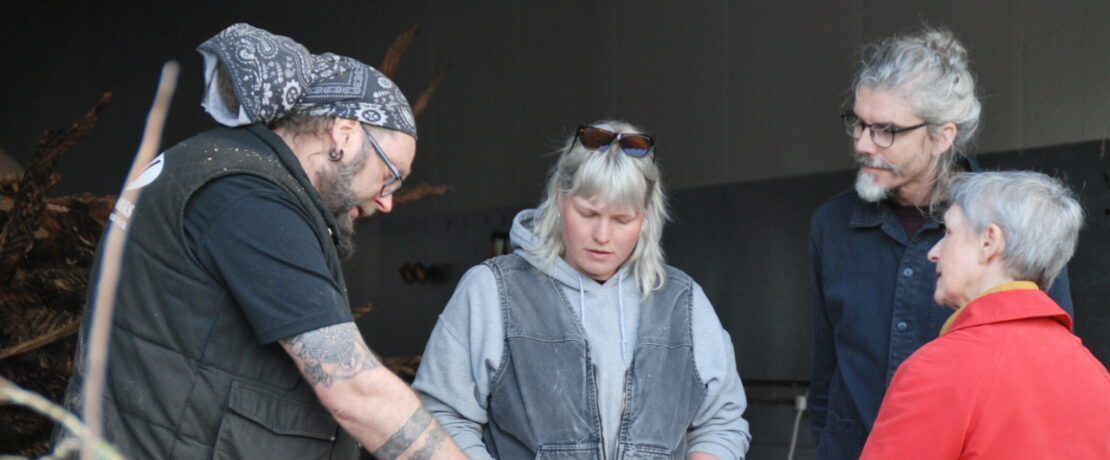
An RHS Chelsea garden takes months to build and minutes to see. What most visitors don’t clock, as they pause to take it in, is the number of people who made it.
The ‘On the Edge’ garden, designed by Sarah Eberle for CPRE’s centenary, shines a light on the countryside on our doorsteps: the edgelands where town and country meet, often undervalued yet full of life and possibility. To tell that story, it takes many hands. For Sarah, bringing those hands together was always central to the vision.
For ‘On the Edge’, that includes a sculptor working in fallen timber, a willow artist weaving what he describes as the spirit of the hedgerow, a pair of siblings from a fifth-generation walling family, and the contractors and metalworkers holding the whole thing together. We caught up with the team to hear what brought them here, and what the garden means to them.
Chris Wood – wood sculpture
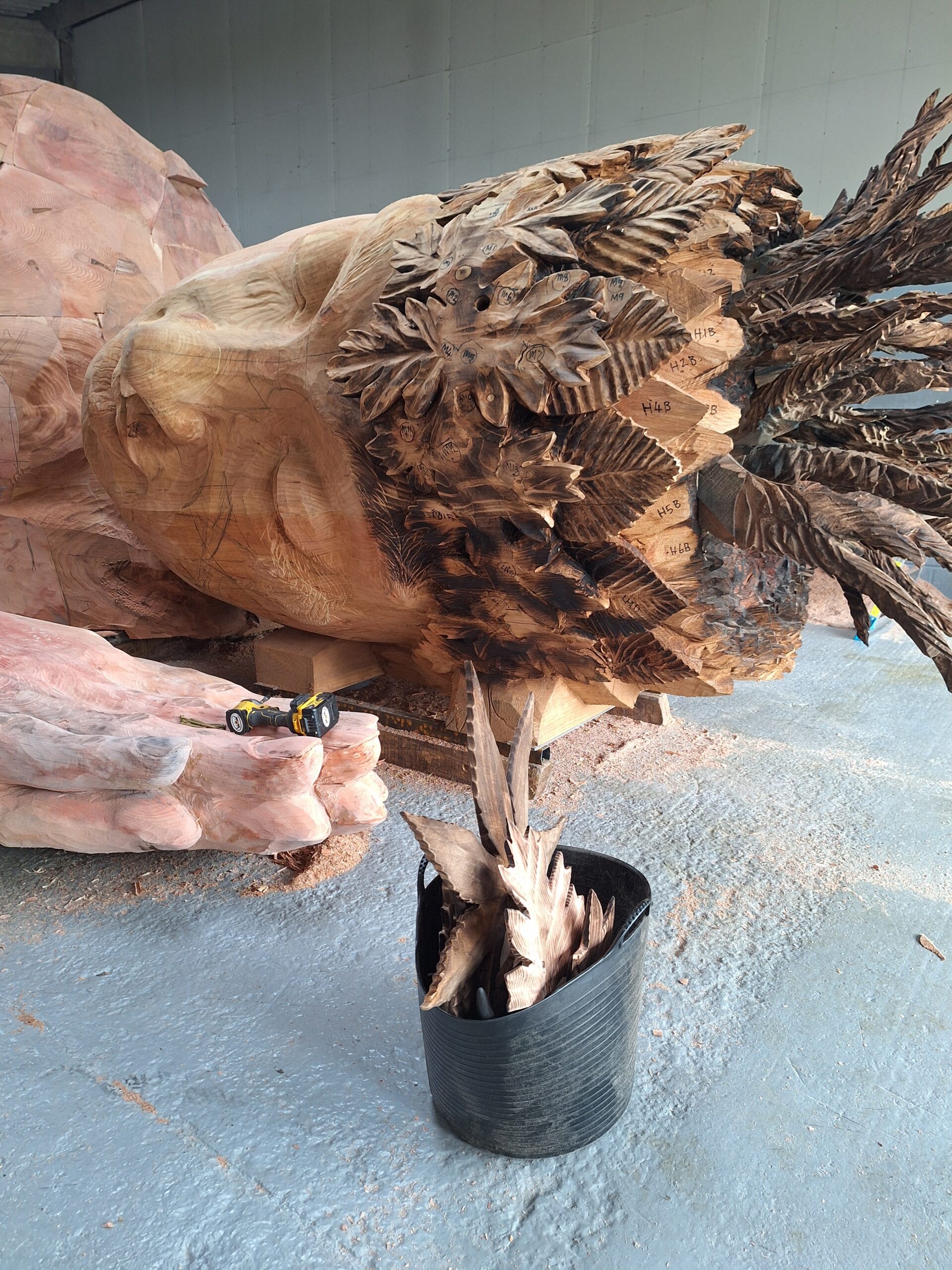
At the heart of the garden sits Gaia, a powerful guardian figure carved from fallen trees. She is being brought to life by chainsaw artist Chris Wood, whose work transforms raw timber into expressive sculpture.
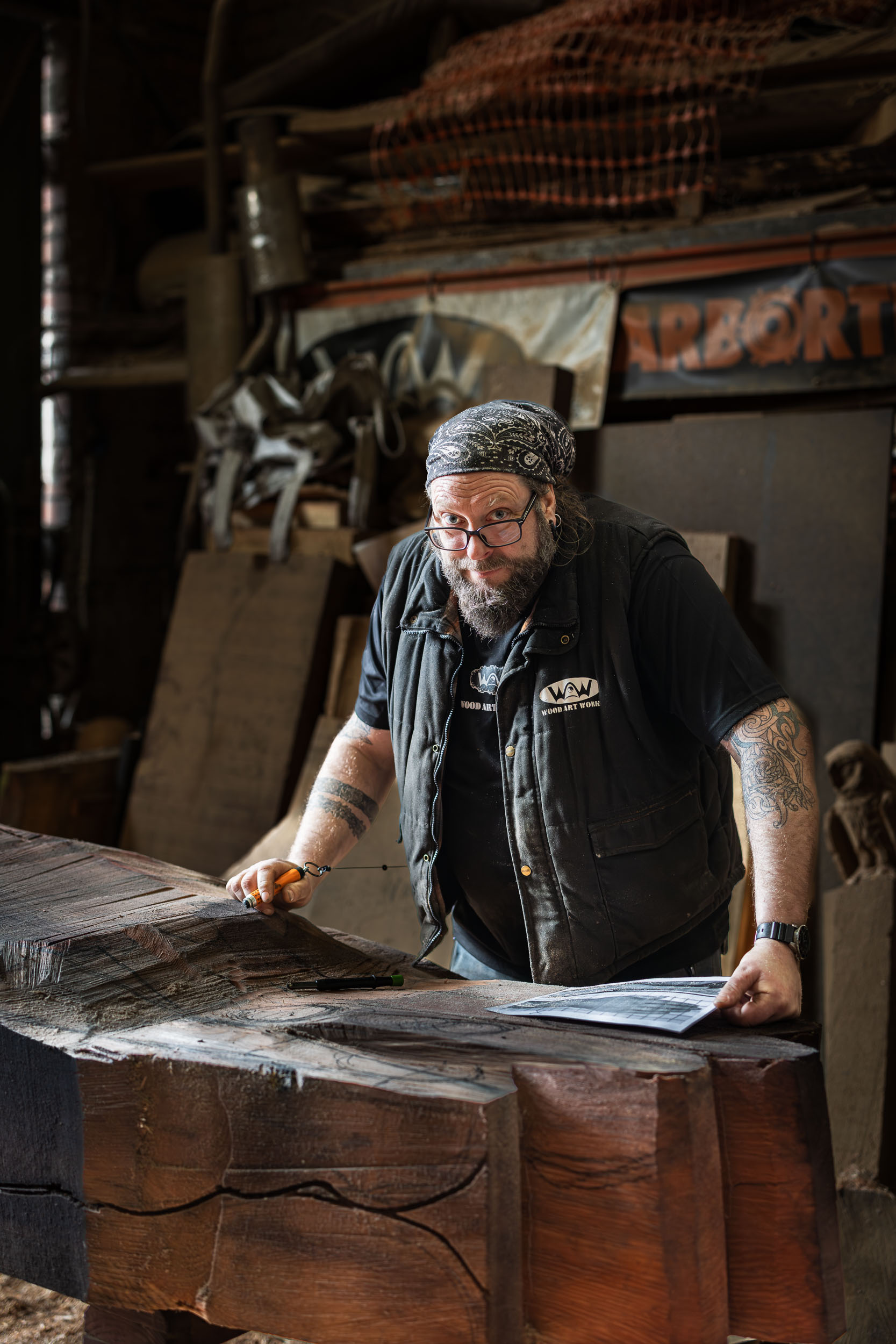
A former fabricator welder turned award-winning chainsaw sculptor, Chris describes his inspiration as rooted in myth and folklore. Green men. Earth goddesses. The deep reservoir of old stories about the relationship between people and land. Gaia fitted naturally into that current of thinking.
The idea for Gaia started as a conversation with Sarah. She suggested a head. Chris pushed for something more. Once he saw the garden plan, the possibilities opened up: a whole torso, a sleeping woman, a figure that could grow with the planting and willow around her. ‘I hate to say organically,’ he laughs, ‘but it did develop organically, which suits the garden, really.’
For Chris, Gaia represents both strength and vulnerability. A reminder that nature can recover, but only if given space to do so.
The sculpture itself is the largest he has made in this style, and one of the most technically demanding. Yet Gaia will never stand alone. She is designed to be part of a living collaboration. ‘When she’s done, with the planting and the willow and the stonework, it’s just going to be breathtaking,’ he says. ‘That’s my hope.’
Tom Hare – willow
From Gaia’s head and shoulders, strands of willow will flow across the garden like hair.
These sculptural forms are being created by willow artist Tom Hare, who has worked with willow for more than 30 years.
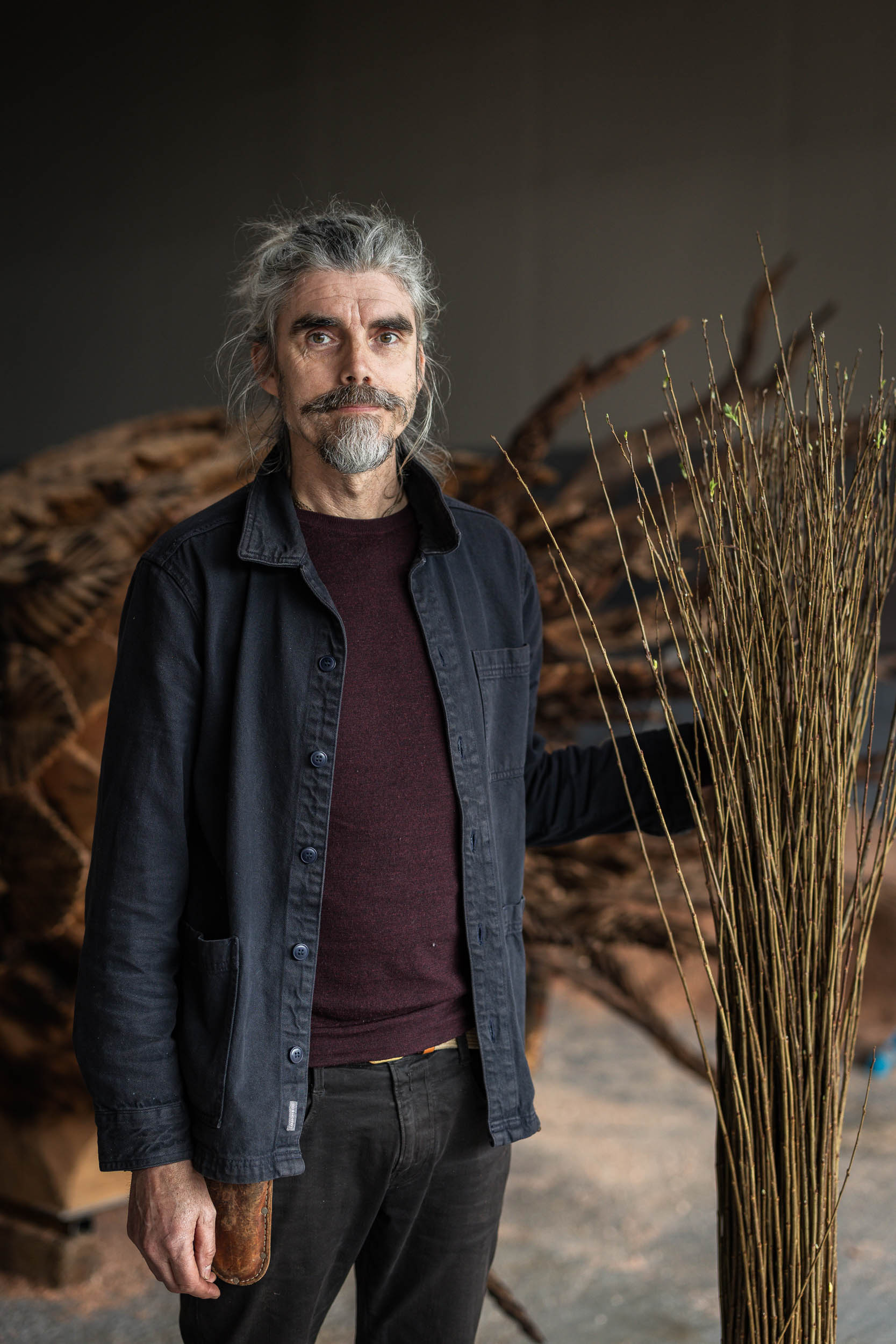
‘I’m making the hair for Gaia,’ he explains. ‘It’s going to flow from the head and shoulders, over the archway, and wrap around the stone wall.’
But the work goes beyond appearance. Tom is weaving not just willow, but fragments of hedgerow: sycamore branches, beech brash and small details that echo the textures of the countryside. ‘I want there to be a sense of the hedgerow in the hair,’ he explains. ‘To bring life into it.’ That connection to everyday landscapes runs through his thinking.
Tom grew up spending time in woodland and travelling to see other forests. He’s lived in an urban part of the Midlands for most of his adult life, and he’s watched what’s happened to the green fringe around it over fifty-odd years. The local woodland that used to be undervalued is now heavily used, possibly to exhaustion, because it’s the only one. People go there for their mental health, for space. And the wildlife, he says, is stuck for where to go. It’s been pushed to the boundaries too. He’s warm about CPRE’s role.
Lydia Noble – dry-stone walling
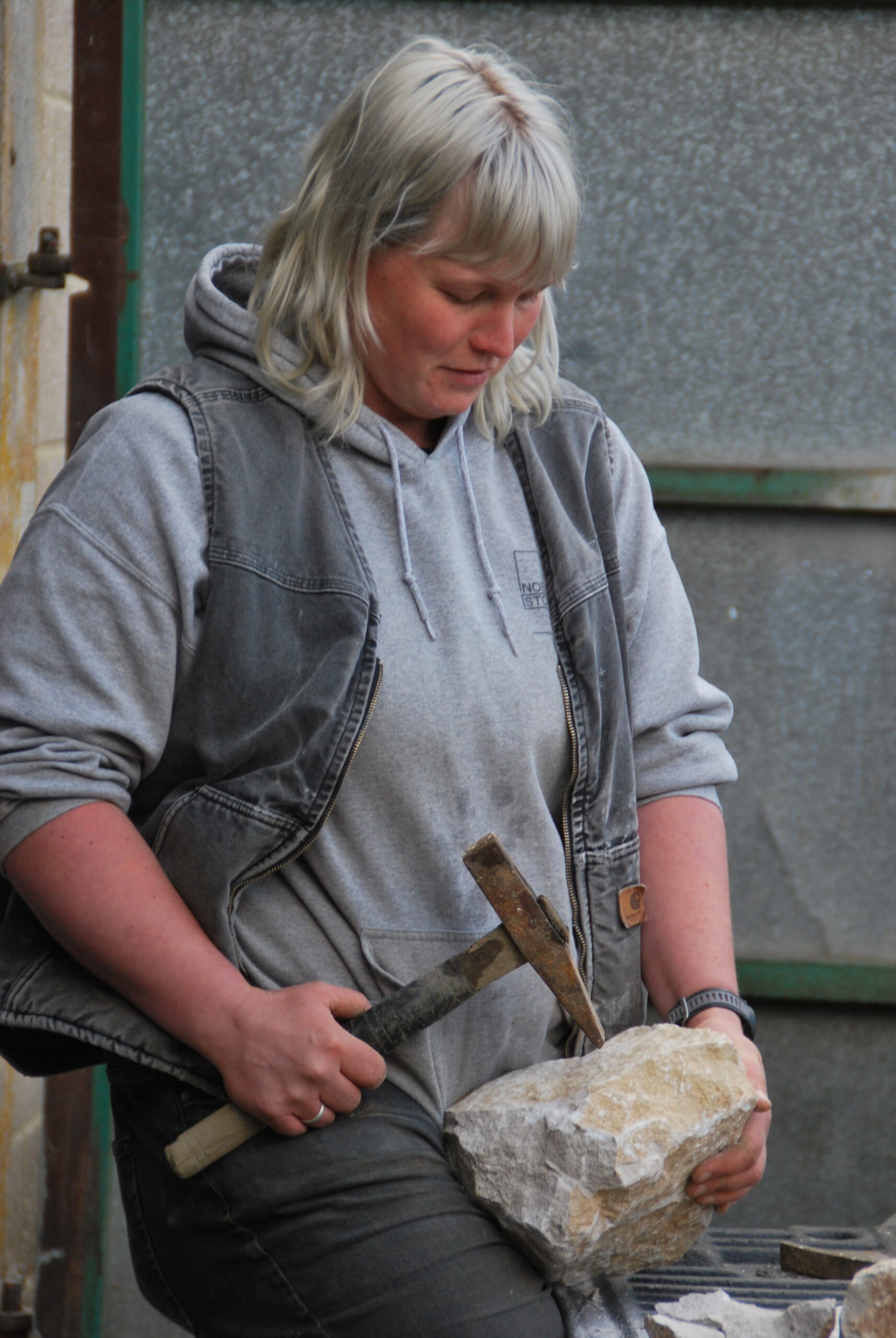
Threading through the garden is a winding dry-stone wall, built by Lydia and Cuthbert Noble from Noble Stonework. Dry-stone walling is a family trade that goes back five generations.
Most of their work is countryside-based, Lydia explains, so RHS Chelsea is always ‘a bit of a change of pace. A bit noisier than we’re used to.’
Unlike modern masonry, dry-stone walls use no mortar. But they do more than define a boundary. ‘All the little gaps create places for wildlife,’ Lydia explains. ‘You get moss and lichen growing, insects moving in — even small mammals using them. They become part of the landscape.’
Each stone is carefully placed so that gravity and friction hold the structure together. ‘They’re all held together just with stone. The big ones at the bottom, small ones at the top, tapering in like a capital ‘A’ that’s called batter.‘ Lydia says. ‘All the pressure’s going inwards and downwards,’ she says, ‘and that’s why they’re such a strong way to build.’ It also means the wall can be taken down and rebuilt elsewhere once the show is over. You take it down piece by piece, put it on a wagon, and rebuild it. ‘You can use every single piece again,’ she says. ‘There’s no waste.’
Three words for dry-stone walling? She takes a moment. ‘Rugged, tactile, chic.‘
It is a craft rooted in patience and precision. And one that speaks directly to the long-term thinking needed to protect the countryside.
Mark Britton – The Outdoor Room (build)
Mark Britton is project manager at The Outdoor Room, the landscaping company that has worked with Sarah Eberle to bring the whole garden together. They have worked on RHS Chelsea gardens for many years. And yes, he says, it gets addictive.
‘Every year we look forward to the new garden coming through the door and seeing what we’ve got to challenge us.’
RHS Chelsea charity gardens are different from other gardens, in his view, but not technically. The difference is in the feeling.
And this one in particular connects. Mark and his team live and work in areas that feel the ‘On the Edge’ message directly: the urban-fringe landscapes, the overlooked edges, the places people walk past without thinking much about. ‘They’re just so important to all of us that if we’re not careful, they’ll disappear. They’re disappearing rapidly as we speak.’
He’s looking forward to visitors experiencing that realisation through the garden. ‘When they come to the show and see these beautiful things, the natural things, the trees, the plants, and how nature comes into the show so rapidly at that point’ — he pauses — ‘it’s nice to get that message across and really just be part of that.’
Steve Flack – Specialised Metal Fabrications
Not every element of the garden will be immediately visible to visitors. Hidden beneath the flowing forms of willow and stone sits a metal structure built by Specialised Metal Fabrications, led by Steve Flack. This structure supports the central arch that connects Gaia, stone and planting into a single composition ‘It’s the support for the main arch assembly,’ Steve explains. ‘It carries the weight of everything above.’
Working behind the scenes is a familiar role for his team, who have supported RHS Chelsea gardens for more than a decade. Each year brings new challenges. ‘Timescales are always tight,’ he says. ‘And every garden is complex in its own way.’
Despite the pressure, RHS Chelsea remains a highlight. ‘We love Chelsea,’ he says. ‘It’s great teamwork. You meet a lot of people. And at the end of it, you have a smile on your face.’
A garden shaped by many hands
Individually, each of these crafts tells its own story. Together, they form something much larger. The flowing willow, the carved timber, the carefully placed stone, the hidden steel, the coordinated build. Each element depends on the others. Just like the landscapes the garden represents.
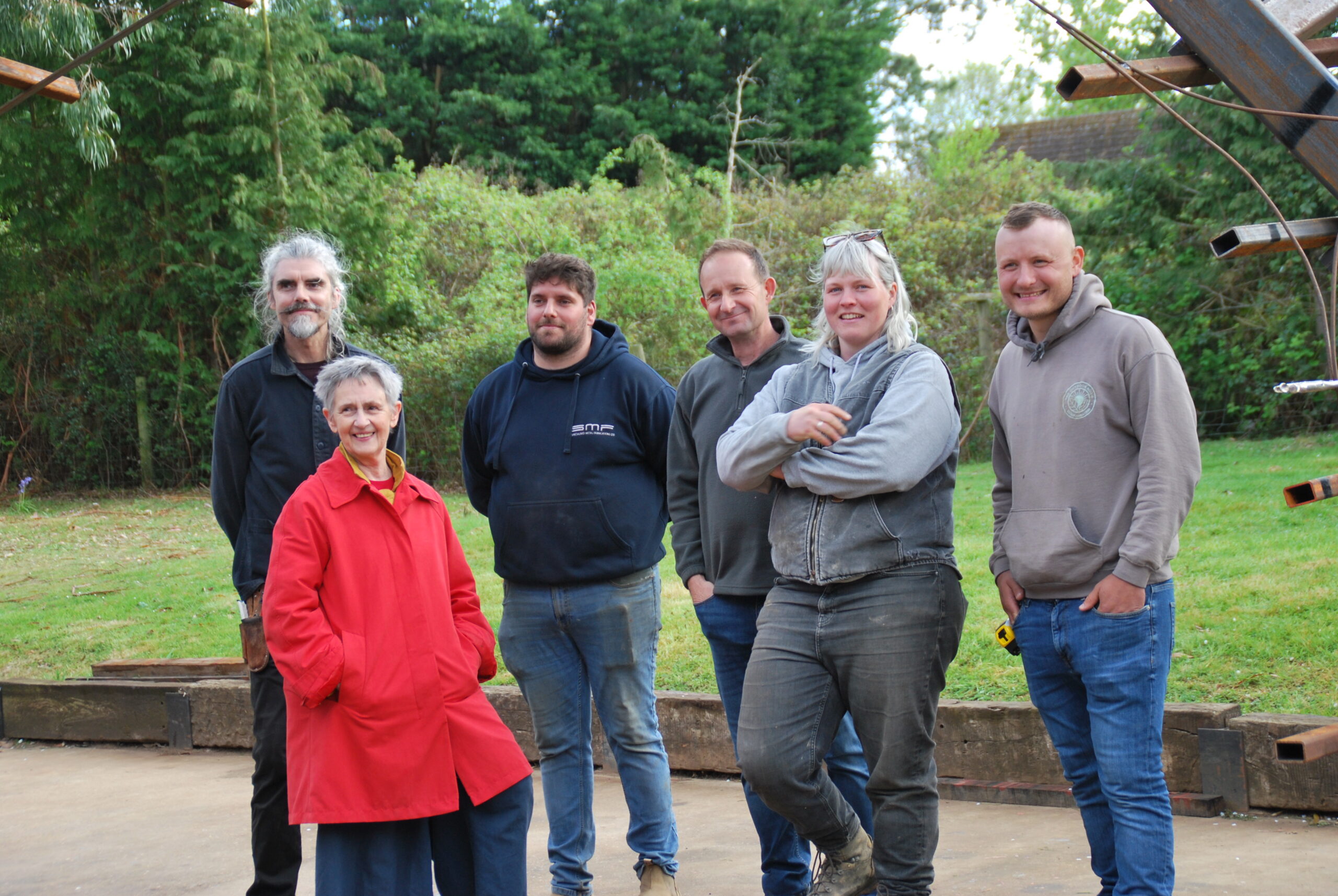
At its heart, ‘On the Edge’ is about recognising the value of places we might otherwise overlook. The scrubby edges, the boundary spaces, the landscapes where community and countryside meet. But it is also about recognising the value of people. The makers, builders and craftspeople whose work shapes the places we live.
When visitors step into the garden at RHS Chelsea, they will see a landscape. What they may not immediately see is the collaboration behind it. Yet it is that collaboration, between people and materials, skill and imagination, that makes the garden possible. And like the countryside it celebrates, it is built with care, patience and the belief that the overlooked things often matter most.