

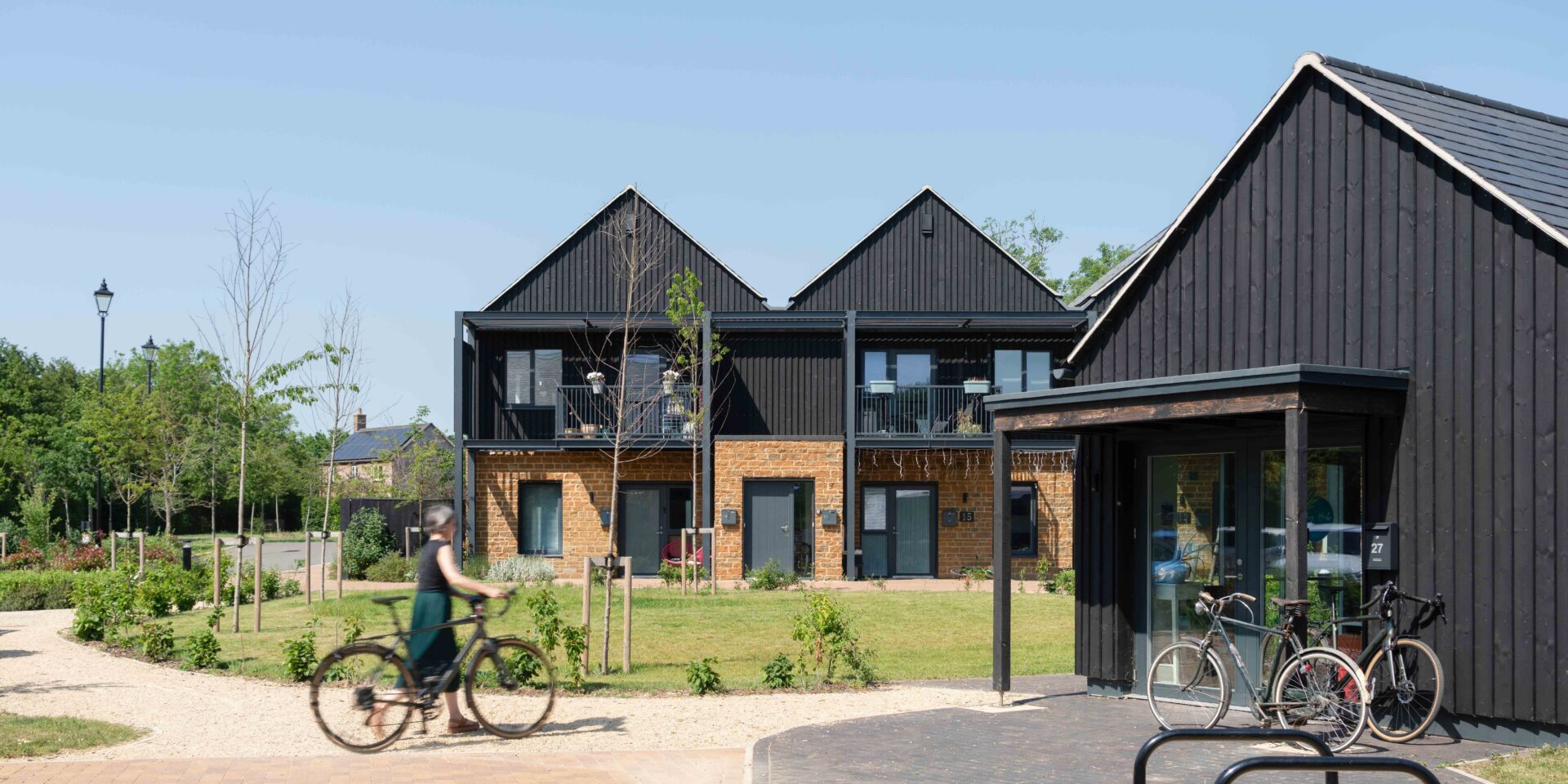

At a time when rural villages are losing the teachers, farmworkers and young families who make them what they are, Hook Norton has built its own solution. Bourne Green is 12 homes — eight for affordable rent, four shared ownership — delivered by Hook Norton Community Land Trust after residents identified affordable housing as their clear priority through years of consultation, surveys and open events. The homes are exceeding Passivhaus standards in occupation and share what’s believed to be the UK’s smallest commercial microgrid, letting residents buy electricity 10% below the price cap. A community car club, co-working hub and therapy rooms sit alongside a new village green, while two new pedestrian bridges have reconnected parts of Hook Norton long separated by earlier development. People who’d left the village have moved back; key workers can now afford to live where they work. It’s proof that a community-led model, and a determined Low Carbon group who went looking for the site themselves, can deliver something bigger than housing alone. A second phase is now extending the landscape strategy into food production, and level access throughout means the community building serves people with mobility needs and respiratory conditions that a standard village hall would not.
Nomination details
Why this matters
The construction of the homes is sustainable and makes use of new techniques. Most housing described as sustainable focuses on one thing: the energy a building uses once occupied.
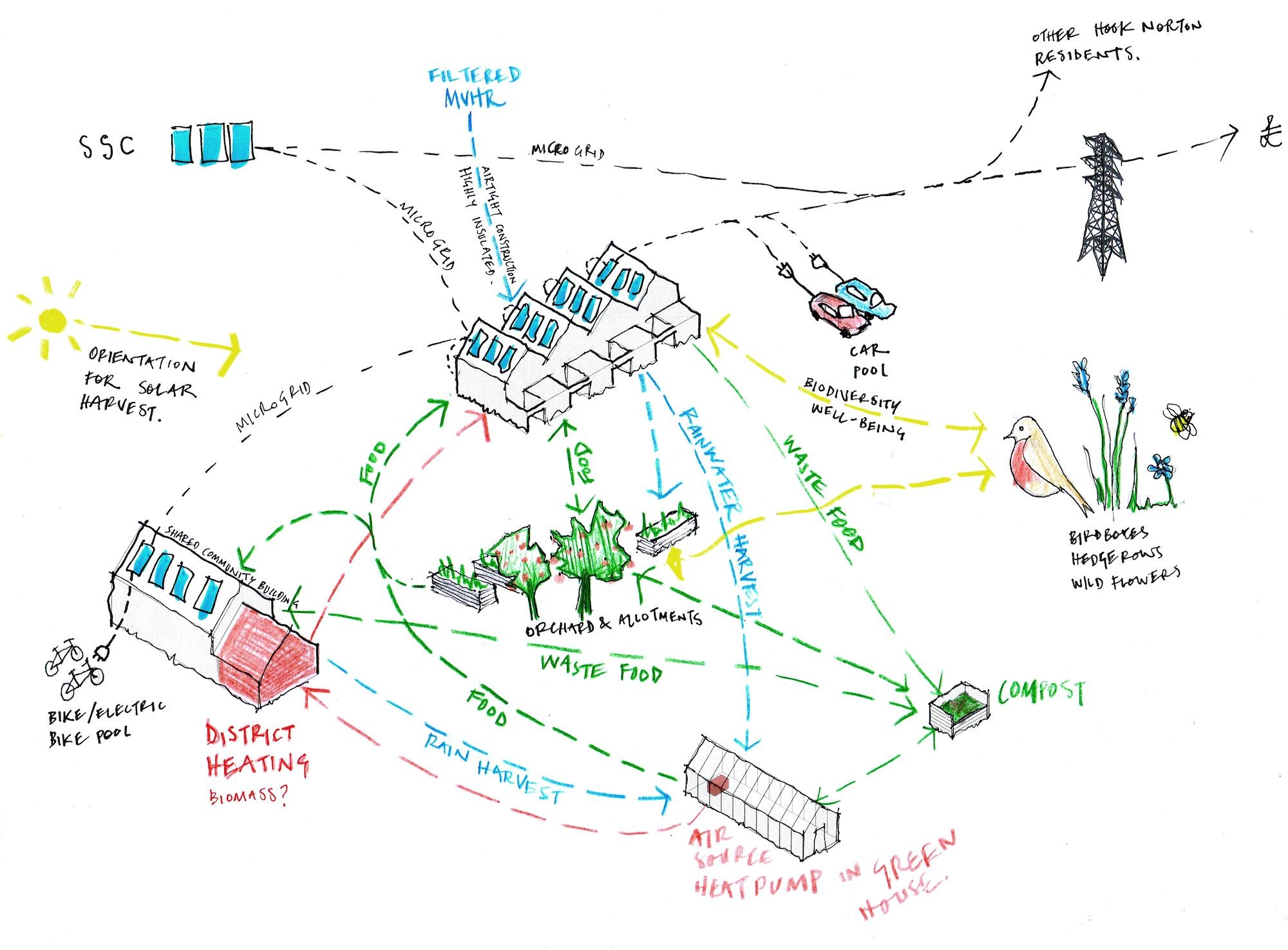
Hook Norton Community Land Trust, working with Charlie Luxton Design, set out to do something considerably more ambitious. Housing in a rural community is not a standalone problem. It sits within a web of interconnected challenges around transport, employment, energy, food and community resilience, and any serious response to those challenges has to be systemic. The homes themselves exceed Passivhaus performance standards in occupation, achieving a level of airtightness and thermal efficiency that keeps running costs extremely low and carbon emissions lower still. They are built using bio-based materials with an embodied carbon of around one tenth that of equivalent developer-led housing. Two terrace blocks provide efficiencies in both construction and thermal performance, with a 68kWp solar PV array across the roofs. The community building is also built using Passivhaus principles, remaining comfortable year-round with minimal heating and cooling. The energy infrastructure is equally distinctive. The project hosts what is believed to be the smallest commercial microgrid in the country, connecting a 50kWp solar PV array on the adjacent Sports and Social Club with the 68kWp array across the roofs of the new homes, all feeding into a 100kWh community battery located centrally on site. The microgrid was designed in partnership with Hook Norton Low Carbon and energy specialists SNRG. Residents are able to buy electricity at 10% below the price cap in a village largely reliant on oil, and the Sports and Social Club benefits from significantly reduced energy costs. The Hooky Hub co-working space within the community building tackles an often-overlooked dimension of rural energy use; bringing people who would otherwise work from separate homes together. Therapy rooms alongside the Hub are available for local practitioners to hire, meaning residents can access physical and mental health support without needing to travel.
Impact
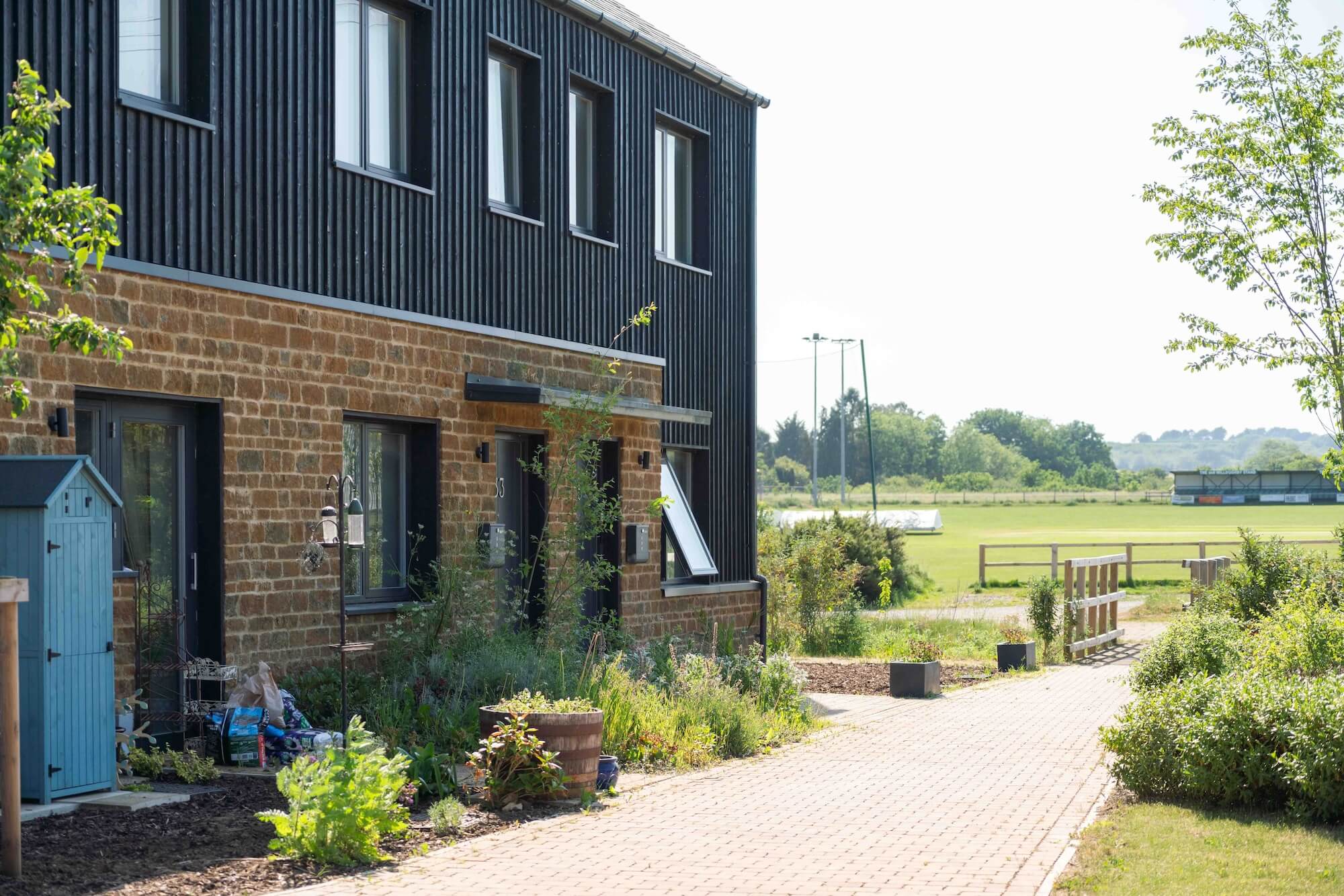
The masterplan for Bourne Green was shaped by the community from the outset, and one of its clearest outcomes was a decision to give a generous proportion of the site over to shared landscape rather than maximising the number of homes. The result is a new village green at the heart of the scheme, designed as a genuinely public space for residents and the wider Hook Norton community alike.
Planting across the site is predominantly native and pollinator-supporting, with fruit trees and native tree varieties throughout. Shared growing beds are available to residents, with a second phase now underway to develop the broader landscape into a productive edible planting scheme. On low-carbon travel, the project goes well beyond providing bike stores and EV charging points, though both are present. The community electric car club, housed on site with five electric vehicles charged from the microgrid’s solar generation, is available to anyone in Hook Norton and the surrounding area at affordable rates. For many rural households, this changes the economics of car ownership in a meaningful way. The co-working space and therapy rooms address travel demand at its source: when people can work, meet colleagues and access health support within their own village, the journeys that never happen are as significant as those made by bicycle or electric vehicle. Perhaps the most tangible contribution to low-carbon movement, however, is what the project has done to the physical fabric of the village. The development included the creation of two new pedestrian bridges and four new access points, connecting the Sports and Social Club, the adjacent Bourne View estate and the new homes to the heart of Hook Norton in a way that had not previously existed. Prior to this, developer-led housing had effectively severed these parts of the village from one another. The new routes have physically restitched the community, creating direct, pleasant connections for people on foot, by bicycle or by skateboard, and in doing so have restored the kind of casual, daily encounters that are the fabric of village life. This has proved to be one of the most celebrated outcomes of the completed project.
People who grew up in Hook Norton and had resigned themselves to leaving have moved back. Key workers who held the village together from a distance now live within it. An artist in her mid-thirties who had been living with her parents has a home of her own. A woman born in the next village, one of nine siblings, working at the local butcher’s shop, has a place that is genuinely hers. These are not abstract outcomes. They are the living proof that the project has done what it set out to do.
Inclusion and accessibility
A second phase of the project, now underway, will extend the landscape strategy to encompass food production, creating an edible landscape that draws the wider community into growing, with all the health and social benefits that brings.
Level access and thresholds throughout, wheelchair-friendly routes across the site, disabled facilities within the building, and a Passivhaus envelope that maintains warmth and exceptional internal air quality at very low running cost mean that the space is genuinely usable by people with mobility needs, respiratory conditions and other vulnerabilities that a standard village hall would not adequately serve. For those who might otherwise find rural life isolating or physically difficult to navigate, the building provides a warm, accessible and affordable point of connection within walking distance of their home.
The buildings, the energy infrastructure, the transport, the working spaces, the health facilities and the food growing are not separate initiatives bolted together. They are understood as nodes in a connected network through which energy, water, people and food all flow. That way of thinking about rural housing is rare. In Hook Norton, it is now built, occupied, and working.