


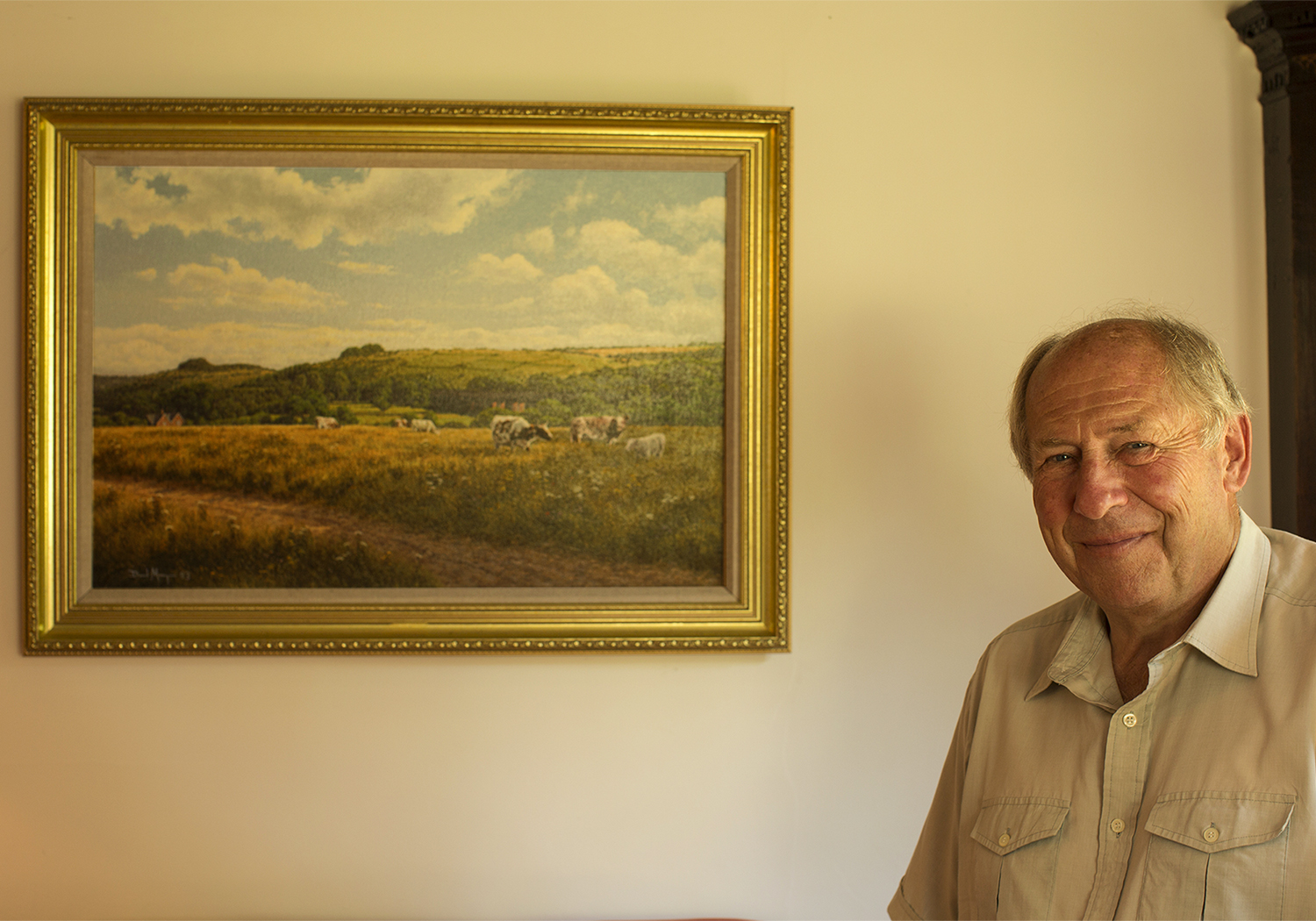

Merrick Denton-Thompson OBE FLI PPLI
Five decades shaping how Britain plans, farms and protects its countryside.
Merrick Denton-Thompson has shaped how Britain’s countryside is planned, farmed and protected for over four decades. As County Landscape Architect for Hampshire, he pioneered Landscape Character Mapping, later adopted nationwide, and helped establish the first Countryside Stewardship Scheme in 1985. He forced a public inquiry into the Twyford Down M3 bypass, despite opposing his own employer, securing lasting EU environmental protections. He founded Learning Through Landscapes, transforming school grounds and environmental education for generations of children, and later served as President of the Landscape Institute. He continues to lead pioneering work on regenerative farming and countryside governance well into retirement.
Nomination details
As County Landscape Architect and head of Countryside for Hampshire he was responsible for a huge number of deeply influential initiatives including;
- Numerous projects across the county, formulation of planning policies and publications with widespread effects well beyond county boundaries.
- Pioneering Landscape Character Mapping in the early 1980’s producing the first County Character Map , presented to the Countryside Commission and then carried out by others across the whole country.
- Working with the 10 Downing Street Policy Unit, put in place the first Countryside Stewardship Scheme in 1985.
- In spite being in opposition to his own employer, campaigned heavily against the Twyford Down M3 Winchester Bypass, forcing the reopening of the public Inquiry and winning support from the EU to secure compliance with the Environmental Impact Assessment Directive.
- Founding trustee of the learning Through Landscapes Trust, the hugely effective organisation set up to improve school grounds and environmental education throughout the country.
- As a member of the Agri-Environment Review Group under Jane Brown, set up the Environmental Stewardship Scheme – Entry and Higher levels.
- Worked with the Cholderton Estate to demonstrate that it is perfectly possible to produce enough food sustainably with regenerative farming – later evidenced with an ELMs Test and trials project.
- From 2006-2009 he served as a board member of Natural England and directed the Rural Pathfinder for the South East of England.
- At the invitation of CPRE he gave evidence to the All Party Parliamentary Group in Westminster on the future modernisation of the Green Belt, directly influencing several of the Group’s final recommendations.
- He served as President of the landscape institute from 2016-18.
- Since this time he has continued to be involved with a range of environmental charities and trusts, the International Federation of Landscape Architects and significantly, as designer and facilitator for Defra’s landmark test and trials pilot project for Farming in Hampshire, testing a new system of local governance (which included CPRE), carbon baseline, methodology and interactive tools for transition to regenerative farming in tune with fundamental landscape character.
- He has been awarded the OBE for his services to education and an honorary doctorate from his alma mater, the University of Gloucestershire.

Why this matters
I believe that nearly everything Merrick has been involved with (as listed above) has resulted in huge positive effects for the countryside. Even where he may feel he failed such as in the fight against the Twyford Bypass, he should take some comfort that reformed processes as a result of the Inquiry will hopefully mean we never see the like of that again.
He is a well loved and hugely respected contributor to so many conversations. While his OBE foremostly recognised his services to education, it has to be remembered that Learning Through Landscapes is likely to have had positive effects on several generations of schoolchildren who are likely to have better valued the countryside as a result.
To me, as a landscape architect and director of his Farming in Hampshire Pilot project for Defra, it is his ability to engage with biggest issues posed by the countryside that has been his biggest contribution; whether the problems of water quality, soils, agricultural practices, depletion of biodiversity and lack of joined up thinking in governance . He is nothing short of passionate in his advocacy for a better countryside and a great advocate and communicator , whether dealing with ministers, farmers, fellow professionals, farmers , students, adversaries and friends alike.
Impact
He has most certainly left a very big legacy of work in Hampshire and that involves all three; communities, people and nature. The work of the Landscape Group he created within Hampshire County Council still continues and this directly influences the management of country parks, schools and highways; planning policies and guidance to managers and potential developers.
His work in pioneering initiatives in education (Learning Through Landscapes), Landscape Character Mapping and environmental stewardship schemes has had a huge impact across the country and the ongoing potential of recent Defra test and trials has the potential for national roll out too.
Inclusion and accessibility
All of the above initiatives have involved aspirations for better access, interpretation and inclusivity.