


Adventures in the North Pennines

By Anita Sethi
You always remember your first times, including your first time in a place. So it is with my first time in the North Pennines.
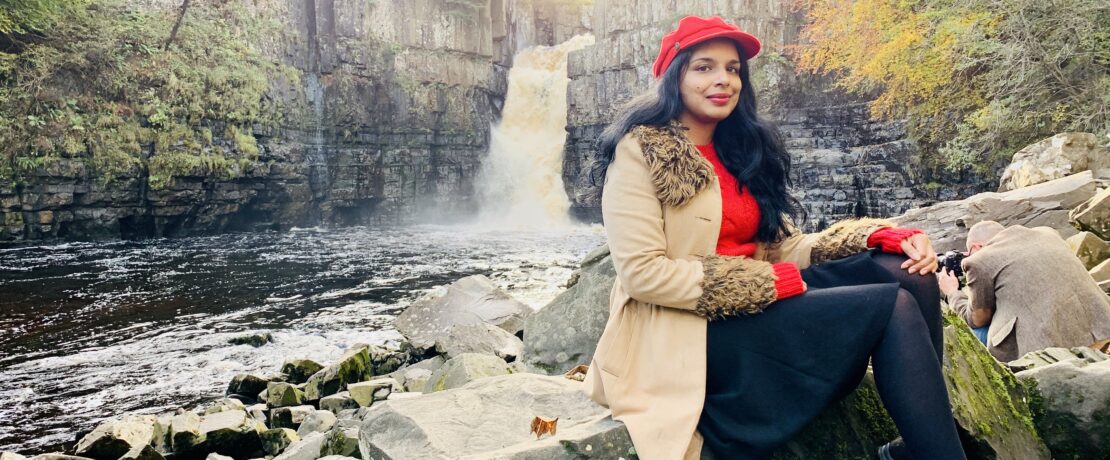
I was lucky that day as I walked through woodland filled with autumn sunlight which set aglow the landscape of deep golds, reds, amber. I listened closely and could just about hear the rush of water. As I walked through High Force Woods, the sound got louder, and then I saw it for the first time, the waterfall, walking ever closer until I stood right before the majestic High Force deep in the North Pennines. I watched it cascading down over the dark rock of the Great Whin Sill. Falling in love with a particular place can be akin to falling in love a person, and with a headlong rush of endorphins, I fell in love with High Force.
I first encountered the region during my walk of the Pennine Way, rising up out of the Yorkshire Dales and into the North Pennines. I planned my walk through the Pennines to follow the course of rivers, and the rivers Tees, Wear, and Tyne all have their sources high up in the North Pennine hills. The pristine health of these headwaters determines the water quality further downstream.
It’s also fascinating to experience this place by both night and day and I returned to High Force a couple of years later and explored the deep dark skies of the area. I wasn’t as fortunate with the weather that time for it was raining ferociously though it was salutary to experience how intense the forces of nature can be in this wild part of the world. The North Pennines has some of the darkest skies in Europe, indeed there are sixteen Dark Sky Discovery Sites, and learning about the night-sky during guided tours and talks is possible during the North Pennines Stargazing Festival. When the skies clear, gazing up into the heavens here is a delight.
I walked on up through the North Pennines and other highlights for me include birdwatching in the area – I loved spotting the lapwings of Langden Beck. And I relished exploring the botanical time-capsule of the Moor House Upper Teesdale nature reserve and its rare arctic plants. A literal highpoint was Alston and taking a picturesque train ride on England’s highest narrow-gauge railway which was a great chance to rest my weary legs.
A walk through a brief history of the North Pennines
How did the North Pennines come to be protected? As well as celebrating the present-day countryside it’s important to understand its history. For this, dive back 100 years in history to 1926 and the birth of the Campaign to Protect Rural England (CPRE) which campaigned for places to be protected by law. In 1988 the North Pennines was finally designated an Area of Outstanding Natural Beauty (AONB), now renamed as National Landscapes.
The North Pennines also borders three of England’s National Parks: the Lake District, Yorkshire Dales and Northumberland National Park. As part of the early campaign to secure the creation of National Parks in England and Wales, CPRE worked alongside other countryside and access organisations including the Youth Hostels Association (YHA) and was involved in the 1947 Hobhouse Report, a landmark government document that proposed the creation of National Parks. It gave evidence at the National Parks Committee in the same year, and in 1949, the National Parks and Access to the Countryside Act was passed. CPRE played a crucial role in campaigning for such legislation and many National Landscapes and Parks like the North Pennines National Landscape are today protected due to this vital campaigning work. However, among other places, CPRE has called the South Pennines ‘unfinished business’ from the original Hobhouse Report which identified the area as one of the 52 ‘Conservation Areas’. Yet still this area remains unprotected in law. Despite recent efforts for the South Pennines to become a regional park, the organisation behind the proposal closed in 2023.
It’s vital to protect and care for our natural landscapes and that they are places that everybody can access and enjoy. I found my time walking through the North Pennines beneficial for both my physical and mental health, and I also learnt just how important the ecosystems of the North Pennines are, having a critical climate and environmental value and being a sanctuary and home for rare wildlife. The area has 40% of the UK’s upland hay meadows, important for its exceptional biodiversity; 36% of it is designated as Sites of Special Scientific Interest; it has 30% of England’s upland heathland and 27% of its blanket bog, beloved of breeding wader birds and acting as natural carbon stores as well as mitigating downstream flooding risks, and naturally filtering much of the region’s drinking water.
Looking forward, it’s crucial that we care for our countryside so that it continues to thrive for the next 100 years and beyond.
Anita Sethi is an award-winning writer, journalist and author of I Belong Here: a Journey Along the Backbone of Britain. @anitasethi www.anitasethi.com
Love your countryside this September
You don’t have to travel to a National Landscape to find countryside worth exploring. This September, CPRE’s Love Your Countryside Month is an invitation to discover and celebrate the everyday countryside too – from familiar footpaths and fields to hedgerows, waterways and green spaces closer to home. Sign up for four weeks of inspiration to help you explore, notice and discover more of the countryside around you.