Landbankers selling rural England by the pound
15 December 2006
Countryside campaigners CPRE [1] today (Friday) launch a campaign against a growing carve up of England’s countryside. It leaves fields and woods at risk of being disfigured and neglected. [2]
Small investors from across the globe are being sold plots of rural land on hundreds of sites across England in order to build homes on them. Their chances of success are very low and their ‘investments’ are likely to fail, because permission to develop cannot be obtained on the great majority of the land.
But that has not stopped more than two dozen separate ‘landbanking’ operations from using glossy advertising and high pressure sales techniques to lure in gullible investors.
CPRE fears top economist Kate Barker’s review of planning, commissioned by HM Treasury and published last week, could pour fuel on the flames of small investor landbanking. [3]
She called for a major review of Green Belt boundaries across England. Landbanking operators may use this to advertise hundreds more plots on Green Belt land for sale, claiming their protected status may soon be lost following the Barker review.
CPRE is combining with MPs from all parties to call for the Government to clamp down on the schemes. Greg Mulholland, Liberal Democrat MP for Leeds North West, has today issued an Early Day Motion (494) supporting our campaign. [4]
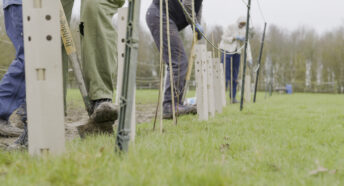
CPRE has found nearly 30 operators involved in buying up land in open countryside and subdividing it into small plots, sometimes with stakes and fences. They then market the plots, mostly via the Internet, as having potential for development, with inflated prices to match.
Yet they do not have the necessary authorisation they need, both from planning authorities and the Financial Services Authority, to realise the potential they refer to – and little hope of ever getting it. Many use seductive but highly questionable claims to suck in investors from all over the globe. [5]
CPRE has surveyed the activities of these companies and found some 200 separate sites across England’s countryside are affected. [6] Once subdivided and sold, the sites are at risk of being disfigured or neglected. [7]
The Government has recently proposed a small change in planning law to prevent the landbanking operators from subdividing land into small plots with unsightly fences and posts. CPRE welcomes the proposal, but on its own it will not be enough to tackle the growing problem. [8]
Much more needs to be done across Government. Councils need to be able to remove fences and stakes already in place, and Government urgently needs to use the powers it has in company and property law to curtail the landbanking operations.
Mark Prisk MP (Conservative, Hertford and Stortford) said:
‘It’s high time the Government acted. In Hertfordshire and across the UK, this landbanking is bad for our countryside and even worse for people tempted to speculate.’
Colin Challen MP (Labour, Morley and Rothwell) said:
‘The trend towards speculative landbanking needs to be arrested, and I hope that the collapse recently of a landbanking company will make people think twice about this capricious threat to our Green Belt.
‘At a time when market pressure, as opposed to sound planning policy, appears to be the preferred post-Barker approach to housing supply, we need to carefully consider who would actually benefit. Landbanking should be discouraged – it is speculation against the countryside.’
Greg Mulholland MP said:
‘Ordinary people are being ripped off and at the same time landbanking scams are causing real distress to many local communities who are worried that important local sites, including in Green Belt land, will be built on.
‘It is time the Government tackled this, to stop people being conned and to protect Green Belt land for future generations to enjoy.’
Paul Miner, CPRE’s Planning Campaigner, said:
‘In Australia they have clear laws to stop this practice and are using them. [9] We shouldn’t have to tolerate it here either. The Department for Communities and Local Government, the Department for Trade and Industry, the Financial Services Authority and the Office of Fair Trading need to work together and stamp it out completely.’ [10]
– END –
NOTES FOR EDITORS
1. CPRE, the Campaign to Protect Rural England, is a charity which promotes the beauty, tranquillity and diversity of rural England. We advocate positive solutions for the long-term future of the countryside. Founded in 1926, we have 60,000 supporters and a branch in every county. President: Sir Max Hastings. Patron: Her Majesty The Queen.
2. CPRE can supply examples of land that has been despoiled by posts and fencing. We believe much of the farmland marketed by landbanking operators is at risk of neglect as a result of being sold to thousands of small investors, many of whom will never visit their land.
3. Barker Review of Land Use Planning – Final Report, HM Treasury, December 2006.
4. Greg Mulholland MP’s Early Day Motion (494) supports CPRE’s campaign and urges the Government to take action to address the landbanking issue. A clear message on the need for action will be sent to Government by as many MPs as possible signing the Motion.
5. See CPRE’s briefing The Great Landbanking Carve-up. Sites marketed by landbanking operators are generally close to other sites designated for housing in local authority plans, and to a layman would seem likely to be developed in the future. To be able to realise the potential gains from developing the site, the individual plot owners would have to apply together for planning permission for homes and/or designation of the site for new housing in the local development plan or sell their plots collectively to a developer. Most, though not all, of the companies we have encountered are claiming to do one or both of these things. CPRE argues that for this to happen the operation would have to be a ‘collective investment scheme’ in law, and need authorisation from the Financial Services Authority (FSA). To CPRE’s knowledge, no landbanking business has such authorisation. See also footnote 9.
6. CPRE has found that the operators listed in our briefing The Great Landbanking Carve-Up are currently holding and / or marketing approximately 200 sites across England. Details of individual sites and the companies marketing them are available from CPRE’s press office.
7. For example, in Stockport Borough, a field that was once lush grazing land was subdivided into plots by Property Spy. It became overgrown and blighted with fly-tipping as a result.
8. Between August and October this year the Department for Communities and Local Government (DCLG) consulted on proposals for changes to ‘permitted development rights’ which allow landbanking companies to put up any number of fences and stakes on their land. The changes would enable local authorities to remove these rights without first having to refer to the Secretary of State, but not in cases where the fences and stakes were already in place.
9. In Australia, the State Government of Victoria has obtained an interim injunction to stop a range of promotional activities by the European Land Sales Partnership. This action, under Section 150 of the (Australian) Fair Trading Act 1999 prevents the company from showing a promotional video or from claiming that it or any of its agents has expertise in either obtaining planning approval for, or development of, land. The matter has been listed for a full hearing in the state Supreme Court. In the meantime the state Government has issued a public warning, stating that ‘Victorians are warned not to buy or enter into contracts to purchase land with the business or its partners without first obtaining independent expert advice or confirmation from relevant councils or planning departments that the land will, or is likely to be, granted residential planning permission in the near future.’
10. CPRE is calling for an urgent, high level meeting of relevant Government departments and regulatory bodies to prepare an action plan for cracking down on the sale of small plots of land to uniformed investors who have not been given the facts they need to know. Actions we would like to see taken include more active regulation of landbankers by the Financial Services Authority, an investigation of the practice by the Office of Fair Trading, and more freedom for local councils to deal with the visual impact of landbanking through planning controls.