Compact Communities: Crucial to the Future of Urban Families
8 May 2008
A new report from countryside campaigners CPRE [1] shows that the exodus of young families from our cities, in search of housing they can afford, is putting immense pressure on our countryside and polarising urban England.
Family Housing - The Power of Concentration also offers a solution: high-quality, higher-density housing which can reinvigorate urban communities.
'A whole section of our cities’ population – young families on moderate incomes – can neither buy unassisted at stratospheric market prices nor qualify for social rented accommodation’, said Steve Whitbread, Director of CPRE London.‘They are forced to move out from town in search of housing they can afford, frequently splitting the city into neighbourhoods of the very rich and very poor. This puts even greater strain on the countryside (for new housing) on transport infrastructure (with so many having to commute into towns to work) and on family life. If we want to halt the continuing breakdown of urban communities, this has to stop.’
Family Housing – the Power of Concentration demonstrates that high quality, reasonably priced – perhaps shared ownership housing can be provided in urban areas at more than 50 dph (dwellings per hectare), with public transport within easy walking distance of every home.
‘Densities at this level not only make public transport, services and local shops sustainable – they make the community viable,’ Steve continued.
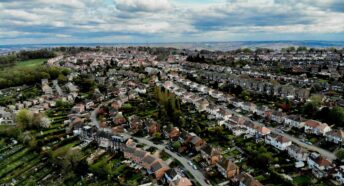
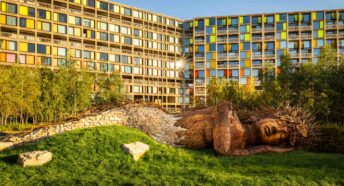
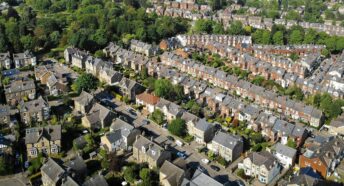
‘Unfortunately, thanks mainly to problems with various infamous high-rise developments of the 1960s and 1970s, planners and, most importantly, the public remain to be convinced. The fact is that the problems of the past resulted mainly from mistakes in design, location and management. The density of these developments was no more than in the streets and squares they replaced. The potential desirability of higher-density housing is clearly demonstrated by the enduring popularity of Georgian and Victorian squares: which were typically built at densities of 80 dph.’
The Power of Concentration uses seven case studies from around the country to show that attractive family housing can be built at densities far greater than the traditional suburban norm of 30 dph or less. Most of the case-study developments – such as the strikingly attractive Iroko, near London’s Waterloo Station – have been selected in part because they have won awards for their design.
‘The report illustrates that the design expertise to build to high quality and at higher densities already exists,’ Steve concluded. ‘We must match this expertise with the political will to ensure our cities get the type of housing they need, where they need it and at a price people can afford. A large and vital section of England’s urban population depends on it.’
– END –
NOTES FOR EDITORS
1. CPRE, the Campaign to Protect Rural England, campaigns for a sustainable future for the English countryside, a vital but undervalued environmental, economic and social asset to the nation. We highlight threats and promote positive solutions. Our in-depth research supports active campaigning, and through reasoned argument and lobbying we seek to influence public opinion and decision-makers at every level.
The continued existence and quality of so much of the English landscape is a testament to our 80 years of successful campaigning. CPRE led the campaign to create the town and country planning system, National Parks, Areas of Outstanding Natural Beauty (AONBs) and Green Belts. Even so, the countryside continues to face a multitude of threats. CPRE campaigns to protect and enhance our landscape heritage for the benefit of all.
2. Family Housing – The Power of Concentration is published on Thursday 8 May by CPRE London and CPRE Kent.